Chemistry Research Updates: Late-Stage Functionalisation, Molecular Glue & Ketone Homologation

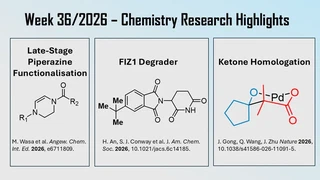
Light-induced oxidation and functionalisation of Piperazine
The piperazine scaffold is a common structural motif in drug discovery projects, recently gaining even more attention as a rigid linker in bifunctional molecules. As tertiary alkyl amines, they are quite inert against functionalisation, and previous attempts to substitute the piperazine ring required harsh conditions. Masayuki Wasa and co-workers from the Scripps Research Institute (USA) have now published a research article in the journal Angewandte Chemie introducing a novel light-induced oxidation strategy to functionalise the piperazine core.

Using a photocatalyst (RFTA) and a stoichiometric oxidant (MnO2), the piperazine scaffold was transformed into the enamine-type unsaturated piperazine. This intermediate, depending on the substitution pattern, could either be isolated or directly transformed into analogues such as the substituted analogues shown in the above figure. Significantly, this method is remarkably mild, and many drugs and drug-like molecules could be functionalised in reasonable yields.
Read more: S. Mori, C. Zhao, and T. Wang, et al., Angewandte Chemie International Edition 2026: e6711809, https://doi.org/10.1002/anie.6711809.
Simple Thalidomide Analogue can degrade FIZ1
In recent years, more and more so-called undruggable proteins have been successfully targeted by PROTACs and molecular glues. In this JACS study, Heeseon An (Memorial Sloan Kettering Cancer Center), Stuart J. Conway (University of California), and co-workers have demonstrated that slightly modified thalidomide can selectively degrade FLT3-interacting zinc finger 1 (FIZ1).
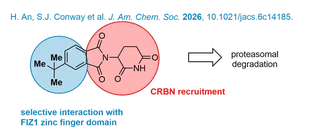
Native thalidomide is a molecular glue which binds to CRBN and can induce proteasomal degradation of target proteins. This concept is widely applied in PROTAC-type drug discovery. However, even small substituents on thalidomide - such as the tert-butyl group in this report - can completely change the selectivity of the molecular glue. The researchers describe that proteomics profiling showed an extremely high selectivity towards FIZ1, an unexpected result for the team. Further downstream studies established the mechanism and the binding mode.
Read more: P. J. Brennan, R. Guo, A. Ordureau, S. E. Singleton, M. Li, F. Albayrak, C. H. Chang, L. Y. Liao, C. M. Deane, K. N. Houk, M. M. Hann, L. L. Brayshaw, H. An, S. J. Conway Journal American Chemical Society 2026, https://doi.org/10.1021/jacs.6c14185.
Ketone Homologation of Aldol Product
Homologation reactions of ketones are a powerful method for ring expansions to synthesize complex molecules. However, they are often hard to achieve. While in modern chemistry diazomethane-type reagents can be used for such homologations, their usage is limited by their explosive and toxic nature. In a new research article by Jieping Zhu and co-workers from the École Polytechnique Fédérale de Lausanne (Switzerland) in the journal Nature, aldol products were used as a suitable starting material.

In detail, an aldol reaction between acids and ketones yielded the aldol product using common methods (such as LDA enolate formation). Next, the researchers developed a novel palladium-catalysed oxidative decarboxylation strategy with carbon migration yielding the homologation product. Notably, stereoinformation from the aldol product is not lost during the rearrangement step; the migrating carbon retains its stereochemistry, while the alpha center of the carboxylic acid is inverted. Overall, this new method was validated with a total synthesis of rupestine D.
Read more: J. Gong, Q. Wang, J. Zhu. Nature 2026. https://doi.org/10.1038/s41586-026-11091-5
