Molecular Editing of Natural Products
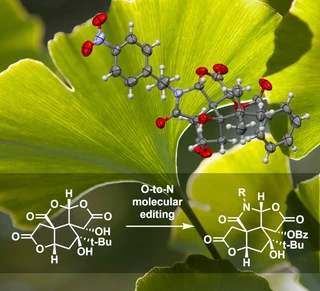
Natural products serve as powerful templates for drug development. The biosynthesis of secondary metabolites demands significant energy from the organism, which suggests that these compounds must serve an important purpose. Indeed, most possess inherent biological activity, even if that activity often remains unknown to us. Shaped by evolution, natural products have conformations already optimized for their biological targets.
The Challenge of Drug Optimization
Yet despite this evolutionary refinement, structural changes are frequently necessary to improve their suitability as drugs. Limitations such as low metabolic stability, poor selectivity, or inadequate cell membrane permeability often stand in the way. As a result, many research groups focus on the late-stage functionalization of natural products.
From Functionalization to Molecular Editing
In recent years, substitution reactions and C–H activation strategies have gained popularity. These approaches allow researchers to decorate natural product scaffolds with functional groups, thereby modulating their ADME properties. Far more challenging, however, is the molecular editing of the scaffold itself. Such efforts often risk disrupting the scaffold’s conformation, leading to a loss of biological activity. Only through careful design of scaffold modifications can we preserve activity while enhancing drug-like properties.
A Project on Bilobalide
Recently, I had the opportunity to participate in such a project. In the research group of Professor Billy Ng, we established a lactone to lactam transformation of bilobalide. Bilobalide is a naturally occurring terpenoid found in the leaves of the Ginkgo biloba tree. Known for its neuroprotective properties, bilobalide represents a structurally complex natural product with multiple lactone rings. These rings contribute to its biological activity but also pose challenges for synthetic modification.
By using its inherent structural isomerization pattern, it was possible to modify both the C ring and the D ring of the natural product. Interestingly, this transformation opens up novel targets and can profoundly alter the molecule’s stability, permeability, and target engagement, making it a valuable strategy in natural product editing.
For the first time, it is now possible to carefully alter the scaffold of bilobalide without losing its biological potential. While biological studies are underway, we are further exploring additional modification strategies.
Literature
Wenjing Wang, Stephan Scheeff, Sam Chun-Kit Hau, Yao Qin, Chanin Sillapachaiyaporn, Billy Wai-Lung Ng (2026). Molecular editing of bilobalide: Regioselective C-ring lactam formation. Org. Lett. 2026, 28, 19, 6027–6031.
Xiaoding Jiang, Xu He, Jonathan Wong, Stephan Scheeff, Sam Chun-Kit Hau, Tak Hin Wong, Yao Qin, Chi Hang Fan, Bowen Ma, Ngai Lam Chung, Junzhe Huang, Jiajia Zhao, Yu Yan, Min Xiao, Xueqin Song, Tony K C Hui, Zhong Zuo, William Ka-Kei Wu, Ho Ko, Kim Hei-Man Chow, Billy Wai-Lung Ng (2024). Lactone-to-lactam editing alters the pharmacology of bilobalide. JACS Au 2024, 4, 9, 3537–3546.
