Total Synthesis of Complex Natural Products
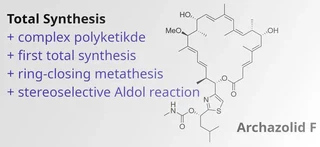
Total synthesis stands as one of the most intellectually demanding and logistically challenging disciplines within organic chemistry. Unlike highly applied branches such as process or routine medicinal chemistry, total synthesis is traditionally driven by academic curiosity and the pursuit of molecular elegance. Success is never guaranteed; indeed, it is not uncommon for a doctoral campaign to outlast the typical span of a PhD program.
The pursuit of highly complex, scarce natural products demands significant timelines and substantial capital investments. Yet, for all its apparent inefficiencies, total synthesis holds profound pedagogical and scientific value. It serves as an unparalleled training ground, teaching young scientists to navigate multi-dimensional problems with systematic rigor, to maintain perseverance over extended timelines, and to embrace intellectual detours as opportunities for innovation rather than setbacks. Beyond its educational merits, total synthesis remains the definitive tool for confirming the absolute configuration of complex architectures, providing access to scarce materials, and enabling the selective structural modifications that lay the foundation for structure–activity relationship (SAR) studies.
It was precisely this intersection of structural complexity, intellectual challenge, and long-term scientific utility that drew me to the discipline.
The Architecture of Myxobacterial Polyketides
During my doctoral studies, I had the privilege of working under the guidance of Prof. Dirk Menche at the University of Bonn, a group known for tackling complex polyketides. Isolated predominantly from marine sponges, mollusks, and soil-dwelling myxobacteria, polyketides exhibit extraordinary structural diversity and potent biological activities against resistant pathogens and cancer cell lines.
From a biosynthetic perspective, polyketides are assembled through the repetitive condensation of simple acyl and malonyl building blocks. However, this apparent structural simplicity conceals an extraordinary density of stereochemical information, where each iteration of the enzymatic assembly line installs new, precise stereogenic centers.
Among these, the archazolids—originally isolated from the myxobacterium Archangium gephyra—represent a particularly interesting class of targets. Functioning as potent inhibitors of the vacuolar-type ATPase (V-ATPase) proton pump, a molecular target deeply implicated in cancer cell survival and metastasis, their structure features a highly functionalized 24-membered macrolactone ring, a characteristic conjugated polyene side scaffold, and a dense array of stereogenic centers.
A Bioinspired Shortcut and the Total Synthesis of Archazolid F
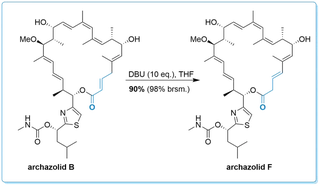
Following the landmark total syntheses of archazolids A and B achieved by the Menche and Trauner groups, my doctoral research focused on a newly isolated variant: archazolid F. Structurally, archazolid F differs from archazolid B solely by the isomerization of a single double bond. Remarkably, this subtle geometric shift confers significantly enhanced biological potency, yet renders archazolid F exceptionally scarce in natural sources.
My investigation began not with an abstract synthetic blueprint, but with a fundamental, biosynthetically inspired question: Could a biomimetic isomerization be used to convert the more accessible archazolid B into its elusive, more potent relative?
Hypothesizing that an enzymatic double-bond migration occurs during biosynthesis, we sought to replicate this transformation chemically. We discovered that treating archazolid B with DBU effected a clean isomerization, smoothly transforming the readily available natural product into archazolid F. This biomimetic semisynthesis provided a rapid proof-of-principle and unequivocally confirmed the structural assignment of the natural product.
However, a semisynthetic shortcut does not constitute a sustainable supply solution for downstream biological evaluation. A fully de novo, scalable, and modular total synthesis was required. Achieving this target demanded extensive strategic optimization. The cornerstone of our successful route relied on a precise Paterson aldol reaction to construct the critical stereocenters with high diastereoselectivity, followed by a late-stage ring-closing metathesis (RCM) to macrocyclize the 24-membered ring, ultimately securing a reliable synthetic pathway to archazolid F.
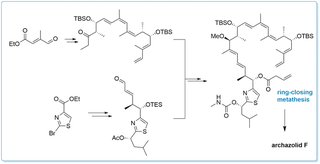
The full total synthesis is shown in Org. Lett. 2019, 21, 1, 271–274 and on my page
Function Through Simplification: Pharmacophore Dissection and Analog Design
With a modular total synthesis established, we turned our attention to a broader medicinal chemistry objective: Can we systematically deconstruct and simplify the archazolid scaffold without sacrificing its subnanomolar biological activity?
We hypothesized that while the macrocyclic core was indispensable for target recognition, the southern thiazole side chain might be structurally redundant. To interrogate the pharmacophore, we designed and executed the synthesis of five targeted analogs.
The most surprising result comes from an analog we termed “archazolog” - a dramatically minimized derivative from which the entire southern thiazole side chain had been excised. To our delight, this minimalist variant completely retained subnanomolar antiproliferative activity, matching the potency of the complex parent natural product.
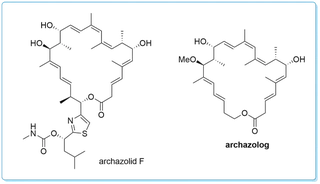
Our studies revealed strict structural boundaries elsewhere in the molecule. The removal of a single methyl ether in the northern hemisphere led to a precipitous loss of potency, confirming its vital role in the binding locus. Furthermore, a linearized, ring-opened analogue proved virtually inactive, in accordance with the non-negotiable role of the macrocyclic conformation in organizing the pharmacophore.
The synthesis of archazolid analogues is shown in J. Med. Chem. 2020, 63, 4, 1684–1698.
Literature
Stephan Scheeff, Solenne Rivière, Johal Ruiz, Simon Dedenbach, Dirk Menche (2021). Modular total synthesis of iso-archazolids and archazologs. J. Org. Chem. 2021, 86, 15, 10190–10223.
Stephan Scheeff, Solenne Rivière, Johal Ruiz, Aliaa Abdelrahman, Anna-Christina Schulz-Fincke, Meryem Köse, Felix Tiburcy, Helmut Wieczorek, Michael Gütschow, Christa E Müller, Dirk Menche (2020). Synthesis of novel potent archazolids: Pharmacology of an emerging class of anticancer drugs. J. Med. Chem. 2020, 63, 4, 1684–1698.
Stephan Scheeff, Dirk Menche (2019). Total synthesis of archazolid F. Org. Lett. 2019, 21, 1, 271–274.
Stephan Scheeff, Dirk Menche (2017). Total syntheses of the archazolids: an emerging class of novel anticancer drugs. Beilstein J. Org. Chem. 2017, 13, 1085–1098.
