Antiviral profiling and cellular activation of carbobicyclic nucleoside analogues
March 12, 2026· ,,,,,,,,,,,·
0 min read
,,,,,,,,,,,·
0 min read
Stephan Scheeff
contributed equally
,Joan Marie Javillo Baguio
contributed equally
,Benny Zhibin Liang
contributed equally
,Josefina Xeque Amada
Kin Pong Tao
Steven De Jonghe
Leentje Persoons
Tiffany Hoi-Yee Chow
Carmen Ka Man Tse
Roy Yukang Wu
Xinzhou Xu
Zhong Zuo
Peter Pak-Hang Cheung
Renee Wan Yi Chan
Billy Wai-Lung Ng
Abstract
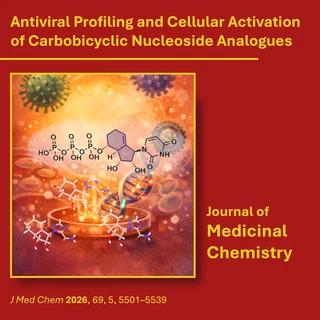
Nucleoside analogues are important antiviral and anticancer agents. In this study, we investigated a new class of nucleoside analogues built on a synthetically accessible carbobicyclic scaffold designed as a conformational mimic of ribose. Antiviral screening of our library revealed pan-antiviral activity against a range of viruses, including HCV, HSV, and influenza. Structure-activity relationship (SAR) studies highlighted the critical role of the carbocyclic scaffold. The uracil analogue 2a inhibited influenza A virus replication through direct disruption of the viral polymerase, as confirmed by a minigenome assay and further supported by in silico modeling. Importantly, metabolism studies demonstrated that congested C5’-OH is readily phosphorylated without the need for prodrug formulations. The resulting triphosphate metabolites are not substrates of human DNA/RNA polymerases, a primary mechanism of nucleoside drug toxicity. Supported by comprehensive synthetic schemes, we present a carbobicyclic scaffold with altered architecture as a promising chemotype for developing novel nucleoside therapeutics.
Type
Publication
J. Med. Chem. 2026, 69, 5, 5501–5539

Authors
Research Associate (Medicinal Chemistry)
Medicinal chemist designing novel antiviral and anticancer compounds. Researched nucleoside analogues at CUHK under Prof. Billy Ng since 2021, awarded Hong Kong Postdoctoral Fellowship 2022/2023. Enjoys exploring Hong Kong’s countryside and culture through photography.