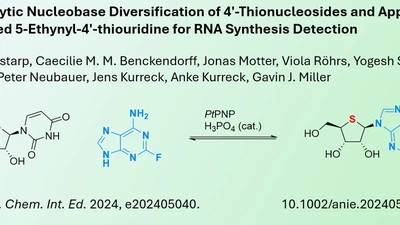
Biocatalytic diversification of thionucleoside analogues
Novel biocatalytic method for the diversification of thionucleosides, demonstrating that enzyme-catalyzed transglycosylation can effectively facilitate nucleobase exchange.
•
1 min read
Novel biocatalytic method for the diversification of thionucleosides, demonstrating that enzyme-catalyzed transglycosylation can effectively facilitate nucleobase exchange.
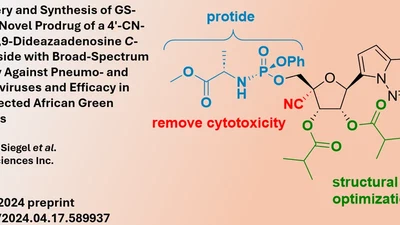
The development of a novel 4'-CN remdesivir-type nucleoside analogue demonstrating the potential of 4-aza-7,9-dideazaadenosine nucleoside analogues to exhibit antiviral activity.


Researchers modified the structure of the established antibiotic bacitracin, leading to a 256-fold increase in activity and potent inhibition of vancomycin-resistant strains.
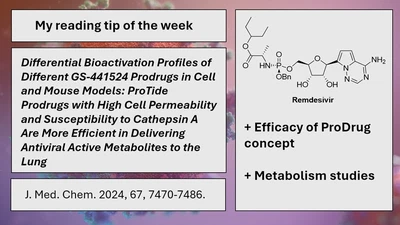
The efficacy of triphosphate formation of remdesivir is dependent on ProTide substitution. Higher levels of triphosphate in the lung are observed with ProTide prodrugs.
![Design and synthesis of bicyclo[4.3.0]nonene nucleoside analogues featured image](/publications/scheeff-2023-hj/featured_hu_b923ed2bcb2d56c8.webp)
Nucleoside analogues are effective antiviral agents, and the continuous emergence of pathogenic viruses demands the development of novel and structurally diverse analogues. Here, …
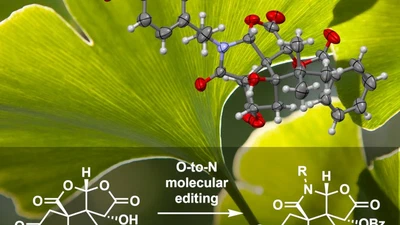
Natural products serve as powerful templates for drug development. The biosynthesis of secondary metabolites demands significant energy from the organism, which suggests that these …
Understanding how to harden liquid condensates produced by influenza A virus could accelerate the development of novel antiviral drugs.
Vacuolar type ATPase (V-ATPase) has recently emerged as a promising novel anticancer target based on extensive in vitro and in vivo studies with archazolids, complex polyketide …